
Customer Support Platform
Use case: customer support. Agents receive suggested answers with sources; tickets are classified and routed.
Business Platforms
REIT Limited, a Bangladesh-based AI services and technical-delivery company, turns connected AI services into configurable platforms for a specific operating need: an interface your team uses, on top of your data, workflows and approval rules.
What a business platform is
A business platform is an interface that brings data, workflows and AI capabilities together for one operating need. Each platform described here is a configured or custom build with an agreed scope and support arrangement. None is an off-the-shelf product, and no public demo account exists.
Each page uses the same structure so the options can be compared.
Use case: customer support. Agents receive suggested answers with sources; tickets are classified and routed.
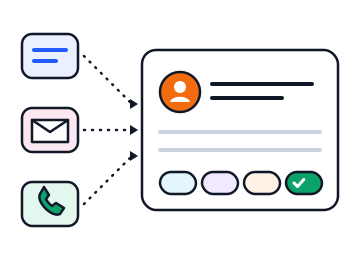
Use case: sales. Enquiries are captured, deduplicated, qualified and written to the CRM with a follow-up draft.
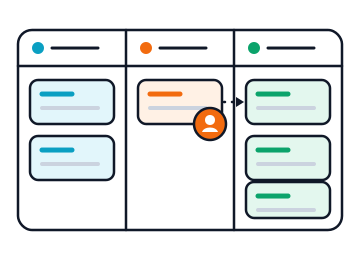
Use case: marketing. Briefs, drafts, approvals and results are held in one workspace.
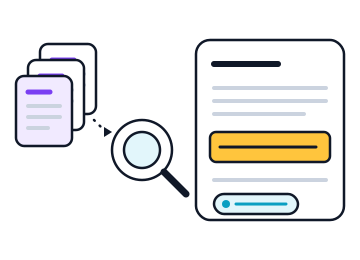
Use case: document knowledge. Approved documents become searchable, with answers linked to their source.
Start from the team that feels the problem, not from the technology. Match the situation in the left column to the platform on the right; if two apply, the assessment decides which to build first.
| If this describes your situation | Consider | First scope is usually |
|---|---|---|
| Agents repeat answers and customers wait for a first reply | Customer Support Platform | One channel, one knowledge source, one queue |
| Enquiries arrive from several places and follow-up is uneven | Sales & CRM Platform | Two intake sources, one CRM, the first-reply draft |
| Campaign requests and approvals are scattered | Marketing Operations Platform | One request form, one approval board, two channels |
| People cannot find what past documents already answer | Document & Knowledge Platform | One document store, one team, source-linked answers |
Reporting is part of every platform: an executive view of volumes and outcomes, a team view of queues and owners, and an exception view of what is stalled or failed. Where an older system must stay in place, it is brought into the platform through an interface in stages, with a rollback plan, and connections are built as a reusable integration layer so later projects do not repeat the work. A platform can be deployed to infrastructure the client owns.
One case study per platform, each with its measures, connected systems and the limit found.
Customer Support PlatformSample
1.9 h
Median first response, was 7.2 h
Online retail · United Kingdom
Sales & CRM PlatformSample
35 min
Enquiry to first contact, was 26 h
Solar installation · Ireland
Marketing Operations PlatformSample
0%
Offers published without legal review, was 22%
Travel · United States
Document & Knowledge PlatformSample
4 min
Time to find a precedent, was 35 min
Engineering consultancy · United Kingdom
| Element | What the proposal defines |
|---|---|
| Interface | The screens and modules your team will use, starting with a small first set. |
| Data | The sources the platform reads and writes, and who owns them. |
| Workflow | The automated steps and the points where a person approves. |
| Integration | Which systems are connected and how; subject to what each system exposes. |
| Approval | Who can approve actions, publish content or change records. |
| Support scope | Who operates the platform after launch and what support covers. |
Operational reporting, such as queue status or campaign results, is included as views inside each platform. Custom internal applications and customer or partner portals follow the same approach: users, modules, data, permissions and support are defined first, then built in stages with a rollback route.
It is a configured build. REIT Limited assembles each platform from agreed modules around your systems, data and approval rules. There is no packaged product to subscribe to and no public demo account. The assessment defines the first scope, and a pilot gives you a working version to evaluate on your own data.
A service is the delivery work: building a workflow, an agent or an orchestration layer. A platform is what your team uses afterwards: an interface that brings those parts together for one operating need. Most platforms are delivered through one or more of the services.
Tell us who would use the platform and which systems it must work with.