Support triage assistant
The agent reads a ticket, searches approved knowledge, proposes a reply and a category, and passes anything outside its limits to a person. Needs: ticket access, approved knowledge sources, escalation rules.
AI Automation & Agents
REIT Limited, a Bangladesh-based AI services and technical-delivery company, builds AI agents for one bounded task at a time, with written limits on what each agent may read, write and do.
What it is
Agentic AI development is the design and build of an AI agent that chooses among permitted tools to complete a bounded business task. Unlike a fixed workflow, the agent decides the next step itself, within an agreed allow-list of tools and actions, and hands the task to a person when it reaches a limit or is unsure.
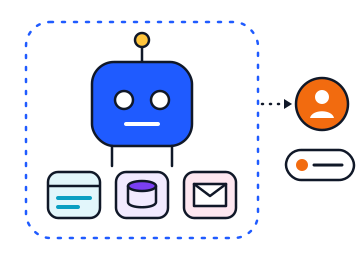
When the task varies too much for a fixed sequence. An agent chooses its next step from a short list of permitted tools, works inside written limits, and hands the task to a person when it reaches a limit or is unsure.
Some tasks cannot be written as a fixed sequence. Answering a varied enquiry may need a search of the knowledge base, a look at the customer record, and a judgement about which reply fits. A rigid workflow breaks on the first unusual case, and a general chatbot with no limits is a risk.
A bounded agent sits between the two. It is given one task, a short list of tools, the knowledge it may consult, and clear limits. If a plain workflow would do the job, this page says so: an agent is not a reason to skip a process map.
Four situations where this service fits, with what each needs from you.
The agent reads a ticket, searches approved knowledge, proposes a reply and a category, and passes anything outside its limits to a person. Needs: ticket access, approved knowledge sources, escalation rules.
Given a new lead, the agent gathers permitted public and CRM information and prepares a short brief for the salesperson. Needs: CRM read access and a list of allowed sources.
The agent collects figures from agreed systems, drafts a weekly summary and flags gaps for a person to check. Needs: read access and the report format.
The agent checks a request against policy documents and prepares the next action for approval. Needs: the policies, the action list and the approver.
A designed, built, tested and documented engagement with written acceptance checks, an operating guide and a handover. This section lists what is included, what is optional, what is excluded and what stays with you.
| Capability | What it covers | Typical tools and connections |
|---|---|---|
| Task definition | One bounded task, its inputs, its completion condition and what counts as a failure | Task brief, test cases |
| Tool allow-list | What the agent can read, write, approve, escalate or refuse | Read-only connectors, scoped API keys |
| Contextual knowledge | Approved documents and records the agent may consult, with access rules | Retrieval index, knowledge base |
| Action limits | Spend limits, rate limits and actions that always need a person | Policy configuration, approval rules |
| Human hand-off | The agent passes the task, with its trace, to a named person | Helpdesk queue, chat, email |
| Evaluation | Task-specific tests on real past cases before and after each release | Evaluation set, pass criteria |
| Traceable actions | Every tool call and decision is logged so a run can be inspected | Action log, trace viewer |
A connection is confirmed in the assessment, after checking the interface, permissions and vendor limits of each system.
The stages are colour-coded the same way across this website: input, processing, human approval, outcome.
One engagement, with the measures agreed before the pilot and reported after launch.
Case studySample case study
Halvarsen Freight Partners · Freight forwarding, Norway
Customer service spent most of each morning answering 'where is my shipment' emails by looking up three carrier portals and the transport system.
Replies about on-time shipments are sent automatically after a two-week supervised period; delays, claims and price questions always go to a person.
68% of tracking questions are now answered without staff time, and the median reply time fell from 5 hours to 6 minutes. Staff review a daily sample of 25 answers.
Two smaller carriers have no API; their shipments are excluded and handled manually until the carriers offer one.
| Period | Value |
|---|---|
| Wk 1 | 22% |
| Wk 2 | 37% |
| Wk 4 | 51% |
| Wk 6 | 60% |
| Wk 8 | 66% |
| Wk 12 | 68% |
Figures from named surveys and official statistics, each with its source.
40%
of respondents from large organisations report scaling AI agents, up from 27% a year earlier; the share at smaller organisations stayed at 22%.
McKinsey & Company, 25 August 2026Large organisations: annual revenue above USD 1 billion
21%
of respondents say their organisations have a mature governance model in place for agentic AI.
Deloitte Insights, 24 April 2026Survey of 3,235 leaders in 24 countries
40%+
of agentic AI projects will be cancelled by the end of 2027 because of escalating costs, unclear business value or inadequate risk controls, Gartner predicts.
Gartner, 25 June 2025Analyst prediction, not a measured result
Through acceptance checks agreed before the build, named approvers for sensitive actions, access limited to what you grant, monitoring with alerts, written recovery steps and a named owner after handover.
Work starts with a paid AI assessment of one process (USD 500, usually 5 working days). A scoped pilot follows (from USD 2,500), then implementation and support, each priced in a written proposal.
USD 500
5 working days
One process reviewed for fit, dependencies and risk.
from USD 2,500
3 to 4 weeks
One bounded use case built and tested on real cases.
from USD 6,000
6 to 10 weeks
The accepted pilot hardened, connected and launched.
Sample pricesPrices exclude third-party licences, model usage and taxes. The proposal sets the final price for your scope. Invoices are issued in USD; GBP, EUR and AUD are available on request.
The first step is an AI assessment of one process or one bounded task. It establishes whether the work is a sound candidate, what it depends on, and what a pilot would cover. An enquiry is a request for that conversation; it is not an appointment or an order.
Build work is quoted in the proposal that follows the assessment. Third-party licences, model usage and hosting are recurring costs and are shown separately from implementation. Ongoing support is a separate arrangement with its own scope. See How We Work for how the stages differ.
Use a workflow when the steps are known in advance. Use an agent when the task must choose among a small set of permitted tools to reach a bounded result. If the choice set is unclear, or the action can spend money or contact a customer, keep a human approval. An agent is not a reason to skip a process map.
Approval is needed for actions that contact a customer, change an important record or commit spend. Escalation applies when the agent's confidence is low or a request falls outside its task. Refusal applies to anything not on the written allow-list. These three rules are agreed during design and tested before launch.
An agent connects through the interfaces each system provides, usually an API, using an account created for it with limited permissions. Whether a connection is possible depends on what the system exposes, the access you can grant and any vendor restrictions. These are checked in the assessment before any commitment to scope.
Tell us the process or task you want to improve, the systems it touches and the result you need.